
News
Nigeria’s elite dividing the Country over political ambitions — Makinde

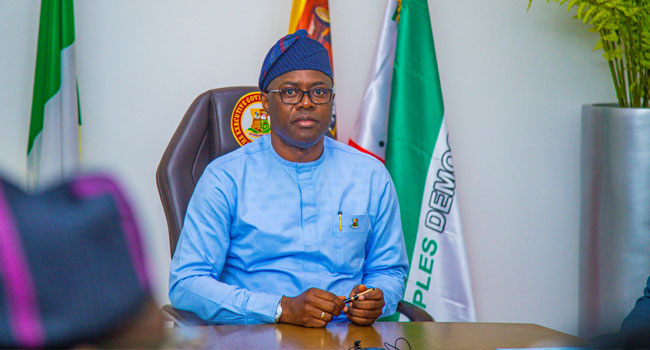
Oyo State Governor, Seyi Makinde, has blamed Nigeria’s political elite for deepening divisions among citizens, saying ordinary Nigerians already share a consensus on the need for a united country.
Makinde made the remarks on Wednesday in Abuja at the public presentation of “Headlines and Soundbites: Media Moments That Defined an Administration,” a book authored by former Minister of Information and Culture, Lai Mohammed.
According to the governor, Nigeria’s challenges are not rooted in ethnic or religious differences among the people but in the political ambitions of the elite class.
“My experience in government has shown me that ordinary Nigerians already have a consensus — they want one Nigeria,” Makinde said. “But the elite, we the elite, are the ones dividing the country because of our ambitions.”
He recalled his early political journey alongside the late former President Muhammadu Buhari and former Oyo State Governor Abiola Ajimobi, noting how their individual political fortunes unfolded over time.
Makinde explained that in 2007, he contested the Oyo South senatorial election on the platform of the defunct All Nigeria Peoples Party (ANPP), alongside Ajimobi, who ran for governor, and Buhari, who was the party’s presidential candidate.
“We all lost that election,” he said. “But four years later, in 2011, Governor Ajimobi won under the ACN. In 2015, President Buhari won. Four years after that, I won and became governor. What that tells us is that only God determines when and how our journeys unfold.”
The governor stressed that patience, humility and perspective are essential in politics, noting that his entire time in public office accounts for less than seven years of his life.
Makinde called for early and broad-based consensus among stakeholders on how to address Nigeria’s present challenges, warning against the dangers of identity politics and exclusion.
He referenced discussions on Nigeria’s independence negotiations, noting that while federalism and multiparty democracy were initially agreed upon, the aftermath of the civil war shifted the country toward a more unitary structure.
“The leaders at the time were focused on one thing — uniting Nigeria after the civil war,” he said. “But we must ask ourselves: is that the same problem we are faced with today?”
Makinde argued that Nigeria must clearly identify its current problems and design governance arrangements capable of addressing them, including moving away from a winner-takes-all political system.
“There must be an arrangement where no one feels excluded politically,” he said. “Only then can we move forward as a country.”






Customs emerge champions of NUJ FCT football tournament

Tinubu to Nigerians: Give Us More Opportunity to Finish the Good Work

Lagos Police Begin Disciplinary Action Against Inspector Over Viral Video

Four Killed as Armed Men Attack Two Niger Communities

Rivers Assembly Issues Arrest Warrant for PAMO VC Over N29bn Funds

Super Eagles Beat Madagascar 2-1 in AFCON 2027 Qualifier
Tinubu Unveils $7bn Ogun Deep Seaport, Blue Marine Economic Zone Investment

Peter Obi Again Denies Borrowing, Issuing Bonds During Eight Years as Anambra Governor

Moghalu Disowns Atiku Campaign Appointment, Says He Was Not Consulted

Ghanaian Lawmaker Sosu Collapses on Stage During Speech
Super Eagles Beat Madagascar 2-1 in AFCON 2027 Qualifier
Rivers Assembly Issues Arrest Warrant for PAMO VC Over N29bn Funds
Lagos Police Begin Disciplinary Action Against Inspector Over Viral Video
Tinubu to Nigerians: Give Us More Opportunity to Finish the Good Work
Four Killed as Armed Men Attack Two Niger Communities
Customs emerge champions of NUJ FCT football tournament
-
 Sports2 days ago
Super Eagles Beat Madagascar 2-1 in AFCON 2027 Qualifier
-
 News2 days ago
Rivers Assembly Issues Arrest Warrant for PAMO VC Over N29bn Funds
-
 News2 days ago
Lagos Police Begin Disciplinary Action Against Inspector Over Viral Video
-
 National News2 days ago
Tinubu to Nigerians: Give Us More Opportunity to Finish the Good Work
-
 News2 days ago
Four Killed as Armed Men Attack Two Niger Communities
-
 NUJ FCT2 hours ago
Customs emerge champions of NUJ FCT football tournament