
NUJ FCT
NUJ, Chevron partner to strengthen energy journalism, AI reporting skills

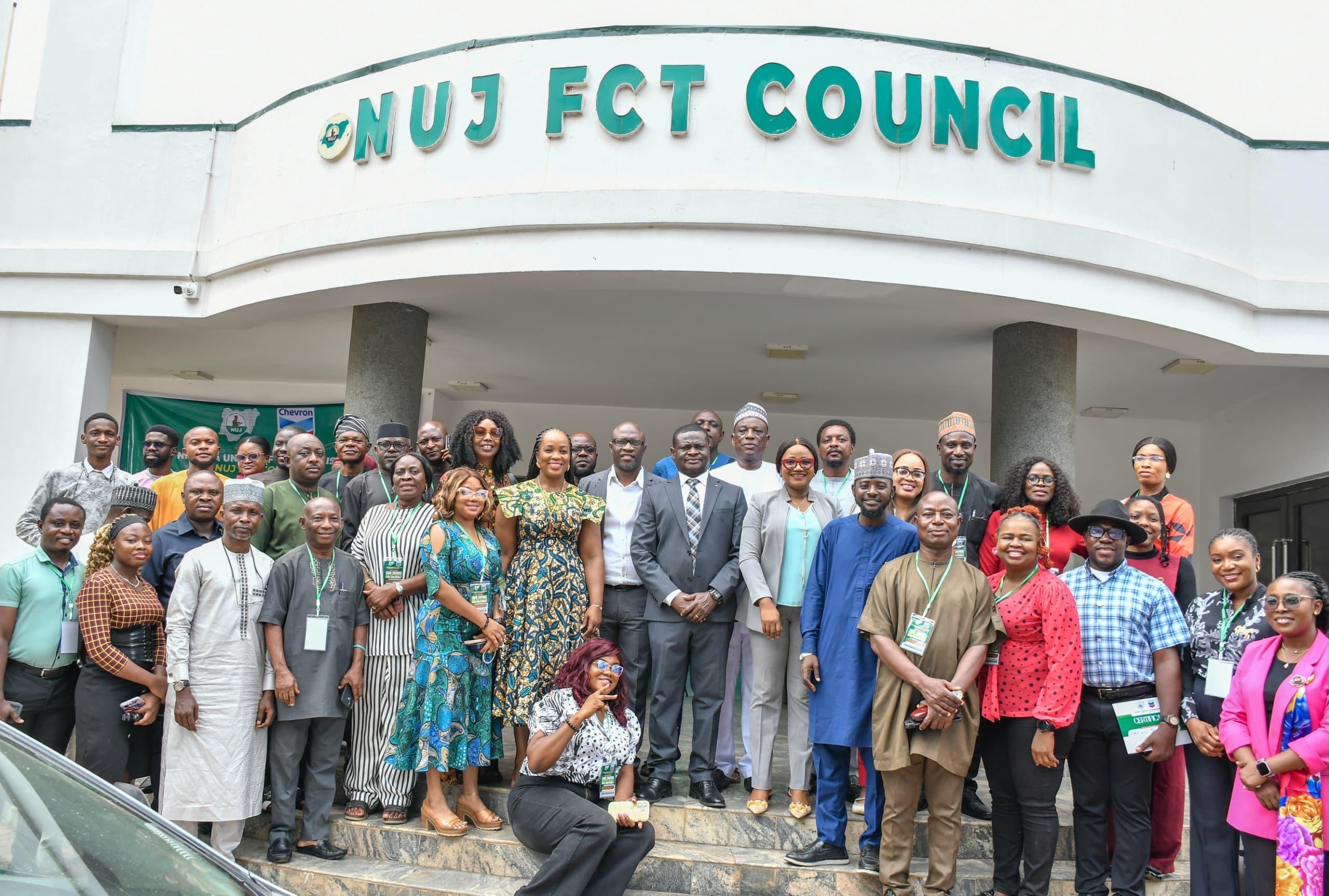
The Nigeria Union of Journalists (NUJ), FCT Council, and Chevron Nigeria Limited have reaffirmed their partnership to strengthen energy reporting in Nigeria through enhanced training in data journalism, technical reporting and the responsible use of artificial intelligence (AI).
The commitment was renewed on Tuesday during the 2026 Chevron Media Capacity Building Programme for Energy Correspondents in Abuja, where media executives, industry experts and journalists highlighted the need for specialised knowledge to improve coverage of Nigeria’s evolving energy sector.
Speaking at the event, Chairman of the NUJ FCT Council, Comrade Grace Ike, said the initiative reflects a shared commitment to equipping journalists with the skills required to report an increasingly technical and data-driven industry.
She described journalists as interpreters of complex systems whose reports influence public trust, investment decisions and government policies.
“The energy sector is technical, rapidly evolving and global in reach. To report it well, we must deepen our understanding of markets, infrastructure, financing and regulation,” Ike said.
She urged energy correspondents to embrace continuous learning to better explain how developments in the sector affect electricity supply, employment, host communities and Nigeria’s economic growth.
According to her, credibility in energy journalism depends largely on the accurate interpretation of data and careful verification of facts.
She cautioned journalists against relying on unverified statistics or publishing figures without proper context, stressing that responsible reporting remains essential to promoting accountability and informed public discourse.
On artificial intelligence, Ike said the technology offers significant opportunities for research, data analysis and newsroom efficiency but should never replace editorial judgment.
“It is a force multiplier, not a replacement for our judgement,” she said.
She encouraged journalists to verify AI-generated information and remain guided by the ethical principles of accuracy, fairness and accountability.
Representing Chevron Nigeria Limited, Dr. Victor Anyaegbudike said the company’s continued investment in media capacity development reflects its recognition of the critical role journalists play in democratic governance and national development.
He announced that Chevron plans to train between 400 and 500 Nigerian journalists over the next three years, building on an earlier pilot programme conducted in partnership with Pan-Atlantic University, Lagos, which trained about 140 journalists before expanding to Abuja, Delta State and other locations.
“Journalists are as important as the Senate, the House of Representatives, the President and the Chief Justice,” he said.
Anyaegbudike noted that effective reporting of Nigeria’s energy industry requires a sound understanding of sector operations, policy, investment trends and emerging challenges.
He also highlighted Chevron’s investments in gas development, local content promotion and host community development, noting that the company has significantly reduced gas flaring through gas gathering and monetisation projects while supporting indigenous firms across engineering, logistics, procurement and oilfield services.
According to him, Chevron has committed about $140 million to development projects in host communities through its Global Memorandum of Understanding framework and the Host Community Development Trust initiative.
While outlining the company’s interventions, Anyaegbudike urged journalists to independently verify corporate claims and rely on evidence in their reporting.
“Do not write from assumptions. Write from knowledge,” he advised.
A major highlight of the programme was a presentation by Abuja Deputy Chief/Editor, Energy/Power, Kingsley Jeremiah, who emphasised that data literacy has become an indispensable skill for energy correspondents.
Delivering a lecture titled Data Accuracy in Energy Journalism: Common Pitfalls, Best Practices and Lessons Learned, Jeremiah warned against the misuse of statistics and advised journalists to understand the meaning, methodology and context of every figure before publication.
He identified confusion between production capacity, actual production, projections and production targets as among the most common reporting errors in the sector.
Jeremiah also urged reporters to distinguish between revenue and profit, investment and earnings, as well as estimates and confirmed figures, while encouraging them to subject official statistics to independent scrutiny.
According to him, every data-driven report should answer three fundamental questions:
“Where did the figure come from? What does it actually mean? What is its context?”
Another resource person, Editor-in-Chief of Forefront Magazine and Online News, Amos Dunia, examined the opportunities and risks associated with artificial intelligence in journalism.
He described AI as a powerful newsroom tool capable of supporting research, translation, data analysis and investigative reporting, particularly in specialised sectors such as oil and gas.
“Journalists must either embrace it or risk being left behind,” Dunia said.
He, however, cautioned that AI-generated information, images, videos and datasets must always be independently verified before publication.
Dunia also highlighted ethical concerns surrounding AI, including misinformation, deepfakes, copyright infringement and algorithmic bias, urging media organisations to establish clear editorial guidelines governing the technology’s use.
He disclosed that AI platforms, including ChatGPT, were consulted during the preparation of his presentation, but noted that even the technology acknowledges its limitations, underscoring the need for rigorous verification.
The programme concluded with participants emphasising that the partnership between Chevron Nigeria and the NUJ FCT Council represents a strategic investment in building a new generation of journalists capable of reporting Nigeria’s evolving energy sector with greater accuracy, context and professionalism.
Speakers agreed that while technology will continue to shape newsroom practices, credibility will remain anchored on verification, ethical reporting and sound editorial judgment.







Lagos-Ibadan Expressway Gridlock Lasts 14 Hours After Seven-Vehicle Crash at Kara

Presidency Dares Peter Obi to Quit 2027 Race Over Anambra Debt Claims

INEC Explains Amupitan’s Absence, Says Chairman Can Delegate Powers to National Commissioners

JAMB Begins Major UTME Review, Plans Life Skills, Critical Thinking Test

Supreme Court Reserves Judgment on Electoral Act 2026 Dispute

Court Orders Tinubu to Be Served With Atiku’s Suit Seeking His Disqualification

BREAKING: Nollywood Icon Olu Jacobs Dies at 84

I Don’t Need a Son to Inherit My Empire, My Daughters Can Lead — Dangote

Wike’s Rainbow Coalition Threat to APC Survival, Cohesion — Onoh

King’s College Concession: Education Workers Threaten Nationwide Shutdown of Unity Colleges

Police Issue Nationwide Red Alert Over Planned Terrorist Attacks on Schools, Churches, Mosques

2027: INEC Promises Transparent, Credible and Peaceful General Election
King’s College Concession: Education Workers Threaten Nationwide Shutdown of Unity Colleges
BREAKING: Nollywood Icon Olu Jacobs Dies at 84
Court Orders Tinubu to Be Served With Atiku’s Suit Seeking His Disqualification

BREAKING: Nigeria’s Inflation Rate Falls to 15.39% in August — NBS
Wike’s Rainbow Coalition Threat to APC Survival, Cohesion — Onoh
I Don’t Need a Son to Inherit My Empire, My Daughters Can Lead — Dangote
Supreme Court Reserves Judgment on Electoral Act 2026 Dispute
JAMB Begins Major UTME Review, Plans Life Skills, Critical Thinking Test
-
 News2 days ago
Police Issue Nationwide Red Alert Over Planned Terrorist Attacks on Schools, Churches, Mosques
-
 News1 day ago
2027: INEC Promises Transparent, Credible and Peaceful General Election
-
 News1 day ago
King’s College Concession: Education Workers Threaten Nationwide Shutdown of Unity Colleges
-
 Entertainment17 hours ago
BREAKING: Nollywood Icon Olu Jacobs Dies at 84
-
 News11 hours ago
Court Orders Tinubu to Be Served With Atiku’s Suit Seeking His Disqualification
-
 News1 day ago
BREAKING: Nigeria’s Inflation Rate Falls to 15.39% in August — NBS
-
 News1 day ago
Wike’s Rainbow Coalition Threat to APC Survival, Cohesion — Onoh
-
 News1 day ago
I Don’t Need a Son to Inherit My Empire, My Daughters Can Lead — Dangote