
News
Supreme Court affirms President’s power to declare State of Emergency

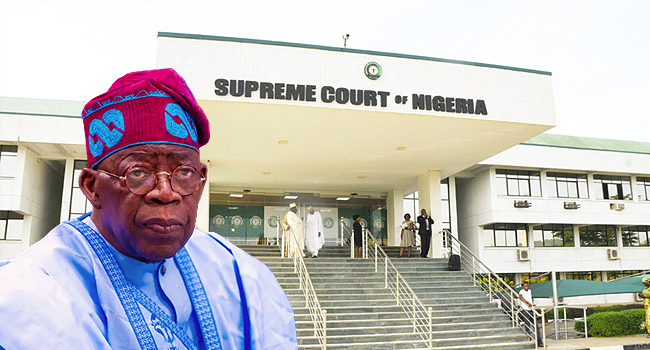
The Supreme Court has upheld the constitutional power of the President to declare a state of emergency in any state of the federation in order to prevent a breakdown of law and order or a slide into chaos and anarchy.
In a split decision of six-to-one, the apex court ruled that the President, during a state of emergency, has the authority to suspend elected officials, but stressed that such suspension must be for a limited and reasonable period.
Delivering the lead majority judgment, Justice Mohammed Idris held that Section 305 of the 1999 Constitution empowers the President to deploy extraordinary measures to restore normalcy whenever emergency rule is declared.
Justice Idris noted that Section 305 does not expressly define the nature or scope of such extraordinary measures, thereby granting the President a measure of discretion on how to address emergency situations.
The ruling followed a suit filed by Adamawa State and 10 other Peoples Democratic Party (PDP)-controlled states, which challenged the legality of the state of emergency declared by President Bola Tinubu in Rivers State. The declaration led to the suspension of elected state officials, including Governor Siminalayi Fubara, for six months.
In the earlier part of the judgment, Justice Idris upheld the preliminary objections raised by the Attorney General of the Federation (AGF) and the National Assembly, who were listed as defendants in the suit.
The court held that the plaintiff states failed to establish a valid cause of action capable of invoking the Supreme Court’s original jurisdiction. Consequently, the suit was struck out for want of jurisdiction.
Despite striking out the case, the apex court proceeded to consider the substantive issues raised and dismissed the suit on its merits, effectively validating the President’s actions under the emergency declaration.
However, the decision was not unanimous. Justice Obande Ogbuinya delivered a dissenting judgment, holding that while the President has the constitutional power to declare a state of emergency, such authority does not extend to the suspension of elected state officials.
According to the dissenting opinion, the President cannot lawfully suspend governors, deputy governors, or members of state legislatures under the guise of emergency rule.
The judgment has far-reaching implications for Nigeria’s federal structure, clarifying the scope of presidential powers during emergency situations while raising renewed debate on the limits of executive authority.

















Gov. Bago distributes vehicles to management staff of Akum

How to check Nigeria Customs 2024/2025 final recruitment list

FG approves reforms to provide 24-hour electricity to 30% of Nigeria’s health facilities by 2027

Atiku questions ₦1.08tn budget allocation to Enugu cooperative college, demands accountability

Amaechi has no electoral value, only Tinubu can win Rivers in 2027 — Wike

Police arrest three suspects over killing of two officers in Rivers, recover stolen rifles

Insecurity: FCT may consider ban on Okada, Keke Napep in parts of Abuja – Wike

Police, EFCC, Army urged to emulate DSS compensation model

NAWOJ announces Maiden Women in Security Summit and Awards

NSITF boss links AI adoption to workplace protection

Oyedepo knocks FRSC bill on bus preaching, says Govt should tackle insecurity instead
NAWOJ announces Maiden Women in Security Summit and Awards
NSITF boss links AI adoption to workplace protection
Atiku questions ₦1.08tn budget allocation to Enugu cooperative college, demands accountability

Catholic Bishops tell Tinubu the truth, Nigeria’s challenges are not his fault — Orji Uzor Kalu

Nigeria Revenue Service issues new tax guidelines for cryptocurrency, other virtual assets
Police, EFCC, Army urged to emulate DSS compensation model
Insecurity: FCT may consider ban on Okada, Keke Napep in parts of Abuja – Wike
Police arrest three suspects over killing of two officers in Rivers, recover stolen rifles

Primate Ayodele urges Tinubu to heed Onaiyekan’s warning, says public anger could shape 2027 poll
-
 News2 days ago
Oyedepo knocks FRSC bill on bus preaching, says Govt should tackle insecurity instead
-
 News1 day ago
NAWOJ announces Maiden Women in Security Summit and Awards
-
 News2 days ago
NSITF boss links AI adoption to workplace protection
-
 News19 hours ago
Atiku questions ₦1.08tn budget allocation to Enugu cooperative college, demands accountability
-
 News2 days ago
Catholic Bishops tell Tinubu the truth, Nigeria’s challenges are not his fault — Orji Uzor Kalu
-
 National News2 days ago
Nigeria Revenue Service issues new tax guidelines for cryptocurrency, other virtual assets
-
 News1 day ago
Police, EFCC, Army urged to emulate DSS compensation model
-
 News1 day ago
Insecurity: FCT may consider ban on Okada, Keke Napep in parts of Abuja – Wike