




News
Economic growth must be anchored on workers’ safety, dignity — NSITF

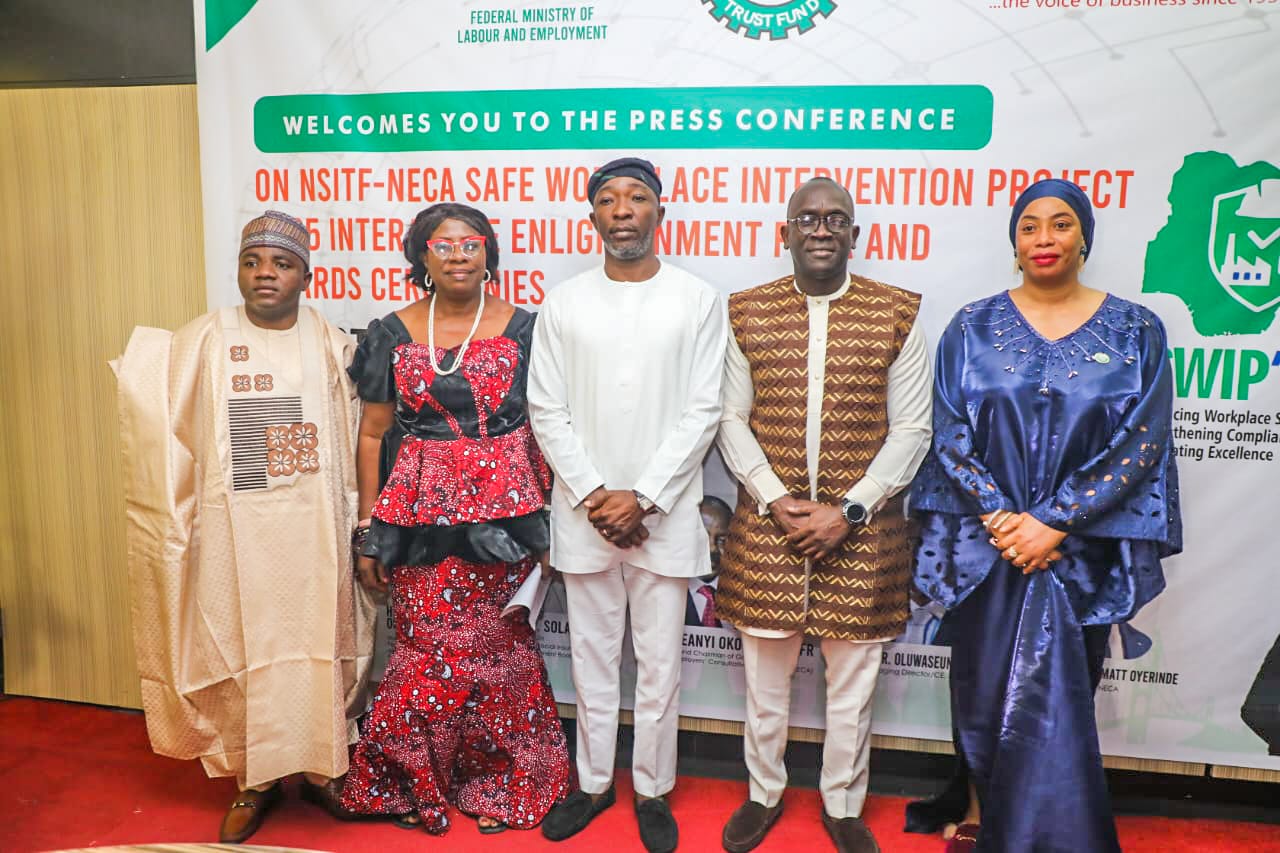
The Managing Director of the Nigeria Social Insurance Trust Fund (NSITF), Barrister Olúwaṣeun Faleye, has said that sustainable economic growth in Nigeria must be anchored on the protection, responsibility to, and respect for Nigerian workers.
Faleye made the assertion at a press conference in Abuja to flag off the 2025 Safe Workplace Intervention Project (SWIP), a collaborative initiative between the NSITF and the Nigeria Employers’ Consultative Association (NECA).
Although originally scheduled for 2025, the NSITF Managing Director explained that operational exigencies on both sides necessitated the reconvening of the programme in January 2026.
Addressing Workplace Risks
Explaining the rationale behind SWIP, Faleye said the initiative was conceived as a response to the persistent exposure of Nigerian workers to avoidable workplace hazards and the low level of compliance with provisions of the Employees’ Compensation Act, 2010.
“SWIP was conceived as a practical response to a persistent national challenge: the reality that too many Nigerian workers remain exposed to avoidable workplace risks, and too many employers still do not fully understand, or comply with, the protections provided under the Employees’ Compensation Act,” he said.
According to him, the project is designed to save lives, protect livelihoods and enhance productivity by making workplace safety and compliance the norm rather than the exception.
Beyond Laws to Behavioural Change
Faleye stressed that legislation alone cannot guarantee safety if it is not supported by awareness, trust and continuous engagement.
“Experience has shown us that laws alone do not change behaviour. Many workplace injuries and fatalities occur not out of malice, but because safety systems are weak, risks are poorly understood, or compliance is seen only as a regulatory burden,” he noted.
He explained that SWIP was designed to bridge this gap by translating statutory provisions into practical understanding, demonstrating the business value of compliance, and reinforcing workplace safety as a human, economic and productivity imperative.
Media Urged to Drive National Awareness
The NSITF boss called on the media to play a critical role in elevating workplace safety to a national priority.
“By telling these stories, highlighting best practices and sustaining public conversation, the media can reposition workplace safety from a peripheral issue to a national concern,” he said.
Ministry of Labour Commends Initiative
The Permanent Secretary of the Federal Ministry of Labour and Employment, Dr. Sally Ousmane, in a speech delivered on his behalf by the Director of Regional Health and Safety, Mrs. Florence Owie, commended the NSITF and NECA for sustaining the initiative.
He described SWIP as a demonstration of the impact of effective collaboration between government, employers and social security institutions.
According to him, the audit component of the 2025 project covered no fewer than 200 workplaces across the six geopolitical zones, with the active participation of the Ministry’s Occupational Safety and Health Department.
NECA Emphasises Global Standards
In his remarks, the Director-General of NECA, Mr. Adewale Smatt Oyerinde, noted that Occupational Safety and Health (OSH) has become a core convention of the International Labour Organization (ILO).
He explained that the goal of the SWIP awards is to encourage voluntary compliance, revealing that selected organisations would receive ambulances and personal protective equipment in Lagos, Enugu and Abuja between January 20 and 27, 2026.
Oyerinde assured stakeholders that the selection process underwent rigorous multi-level auditing and vetting, adding that future OSH efforts would increasingly focus on emerging challenges such as artificial intelligence, remote work and technological innovations.
Call for Sustained Collaboration
Also speaking at the event, the Executive Director, Operations, NSITF, Hon. Mojisola Ali-Macaulay, described the joint assessments conducted by the Ministry of Labour and NSITF as proof that safe workplaces are achievable, not aspirational.
She urged employers to institutionalise preventive safety measures, called on awardees to serve as safety ambassadors, and encouraged NECA to intensify advocacy and employer mobilisation.
Ali-Macaulay further appealed to all stakeholders to deepen collaboration through evidence-based inspections, faster interventions and stronger enforcement, while urging the media and the public to keep occupational safety and health firmly in focus.
“Safe work is everyone’s responsibility and a foundation for national productivity and economic stability,” she said.




News4 minutes ago
IGP urges court to dismiss El-Rufai’s ₦1bn rights suit

Sports10 minutes ago
Anthony Joshua relocates to Dubai, family confirms

National News16 minutes ago
NiMet issues Meningitis alert across Northern Nigeria

National News19 minutes ago
UK tightens security as Tinubu begins state visit to Windsor

News23 minutes ago
PDP, Labour Party lose 11 Lawmakers to APC, ADC in fresh defections

Business27 minutes ago
30 Nigerian Banks meet CBN recapitalisation rarget ahead of deadline

National News46 minutes ago
FCCPC probes airlines over Christmas fare hike, sanctions loom

News49 minutes ago
PSC promotes 13 commissioners of Police to AIG rank

News9 hours ago
South African Army chief visits Nigerian military institutions to strengthen cooperation

News9 hours ago
Five rescued, three dead as bus plunges into river in Ibadan

Uncategorized10 hours ago
Empowering Women: Economic, social necessity –Faleye

Sports1 day ago
Kano Governor sacks Head of Service Abdullahi Musa

News1 day ago
Iran warns protesters supporting foreign enemies will be treated as ‘enemies’

Sports1 day ago
Flying Eagles midfielder Daniel Daga sentenced to six months in Norway

News10 hours ago
Celebrating Funke Ishola: A Trailblazer and pillar of empowerment

News1 day ago
Traders shut down Lagos International Trade Fair Complex over takeover concerns

World News1 day ago
Iran’s new Supreme Leader Mojtaba Khamenei injured but safe, official says

World News1 day ago
Nigerian among victims as UAE intercepts Iranian missiles

National News1 day ago
Tinubu nominates Lamido Yuguda as CBN Deputy Governor

News1 day ago
Defence Minister meets service chiefs over rising insecurity
-
 Uncategorized10 hours ago
Empowering Women: Economic, social necessity –Faleye
-
 Sports1 day ago
Kano Governor sacks Head of Service Abdullahi Musa
-
 News1 day ago
Iran warns protesters supporting foreign enemies will be treated as ‘enemies’
-
 Sports1 day ago
Flying Eagles midfielder Daniel Daga sentenced to six months in Norway
-
 News10 hours ago
Celebrating Funke Ishola: A Trailblazer and pillar of empowerment
-
 News1 day ago
Traders shut down Lagos International Trade Fair Complex over takeover concerns
-
 World News1 day ago
Iran’s new Supreme Leader Mojtaba Khamenei injured but safe, official says
-
 World News1 day ago
Nigerian among victims as UAE intercepts Iranian missiles