









News
Supreme Court affirms President’s power to declare State of Emergency

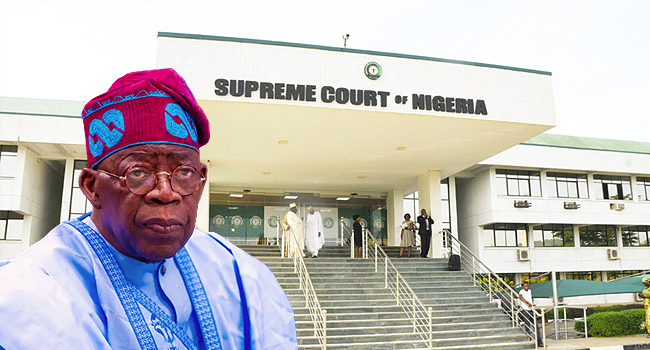
The Supreme Court has upheld the constitutional power of the President to declare a state of emergency in any state of the federation in order to prevent a breakdown of law and order or a slide into chaos and anarchy.
In a split decision of six-to-one, the apex court ruled that the President, during a state of emergency, has the authority to suspend elected officials, but stressed that such suspension must be for a limited and reasonable period.
Delivering the lead majority judgment, Justice Mohammed Idris held that Section 305 of the 1999 Constitution empowers the President to deploy extraordinary measures to restore normalcy whenever emergency rule is declared.
Justice Idris noted that Section 305 does not expressly define the nature or scope of such extraordinary measures, thereby granting the President a measure of discretion on how to address emergency situations.
The ruling followed a suit filed by Adamawa State and 10 other Peoples Democratic Party (PDP)-controlled states, which challenged the legality of the state of emergency declared by President Bola Tinubu in Rivers State. The declaration led to the suspension of elected state officials, including Governor Siminalayi Fubara, for six months.
In the earlier part of the judgment, Justice Idris upheld the preliminary objections raised by the Attorney General of the Federation (AGF) and the National Assembly, who were listed as defendants in the suit.
The court held that the plaintiff states failed to establish a valid cause of action capable of invoking the Supreme Court’s original jurisdiction. Consequently, the suit was struck out for want of jurisdiction.
Despite striking out the case, the apex court proceeded to consider the substantive issues raised and dismissed the suit on its merits, effectively validating the President’s actions under the emergency declaration.
However, the decision was not unanimous. Justice Obande Ogbuinya delivered a dissenting judgment, holding that while the President has the constitutional power to declare a state of emergency, such authority does not extend to the suspension of elected state officials.
According to the dissenting opinion, the President cannot lawfully suspend governors, deputy governors, or members of state legislatures under the guise of emergency rule.
The judgment has far-reaching implications for Nigeria’s federal structure, clarifying the scope of presidential powers during emergency situations while raising renewed debate on the limits of executive authority.
















News1 hour ago
23 Killed, 108 injured in Maiduguri suicide bomb attacks – Police

News1 hour ago
NRC explains cause of Abuja–Kaduna rail disruption

News13 hours ago
BREAKING: Several injured as explosions rock Maiduguri

World News17 hours ago
Iran tells UN it will not submit to ‘lawless aggression’

Entertainment17 hours ago
Burna Boy sets record with $3.1m Oceania Tour revenue

Sports17 hours ago
Chelsea fined £10.75m over historical transfer payments

News17 hours ago
INEC calls for mass voter education ahead of 2027 elections

News17 hours ago
Passengers injured as Abuja–Kaduna train suffers mid-journey incident

News24 hours ago
FAAN, Military apprehend bandits near Akure Airport runway

Sports1 day ago
Iran Men’s Football team set to participate in W’Cup despite safety warnings

FCT News2 days ago
Police recover stolen vehicle, arrest suspect in Abuja

Sports1 day ago
FIFA fines Nigeria, DR Congo over match misconduct

FCT News1 day ago
Fear grips FCT Communities after suspected bandits issue warning

News1 day ago
Zamfara Gov approves Managing Director for new International Airport

National News1 day ago
Tinubu directs nationwide rice distribution for Ramadan, Lent

World News1 day ago
Trump: US in talks with Iran, but Tehran not ready for deal

Sports1 day ago
Joan Laporta reelected Barcelona President until 2031

News1 day ago
Zamfara Educator killed in bandit kidnapping despite ransom paid

World News1 day ago
Middle East conflict drives oil prices higher amid supply disruptions

News2 days ago
IGP Disu urges Police Officers to uphold integrity during surprise visit to NUJ FCT
-
 Sports1 day ago
FIFA fines Nigeria, DR Congo over match misconduct
-
 FCT News2 days ago
Police recover stolen vehicle, arrest suspect in Abuja
-
 National News1 day ago
Tinubu directs nationwide rice distribution for Ramadan, Lent
-
 World News1 day ago
Trump: US in talks with Iran, but Tehran not ready for deal
-
 FCT News1 day ago
Fear grips FCT Communities after suspected bandits issue warning
-
 News1 day ago
Zamfara Gov approves Managing Director for new International Airport
-
 News17 hours ago
INEC calls for mass voter education ahead of 2027 elections
-
 Sports1 day ago
Joan Laporta reelected Barcelona President until 2031