
News
Atiku’s Fuel Subsidy Proposal Is Political Strategy, Not Economic Policy — Fayemi

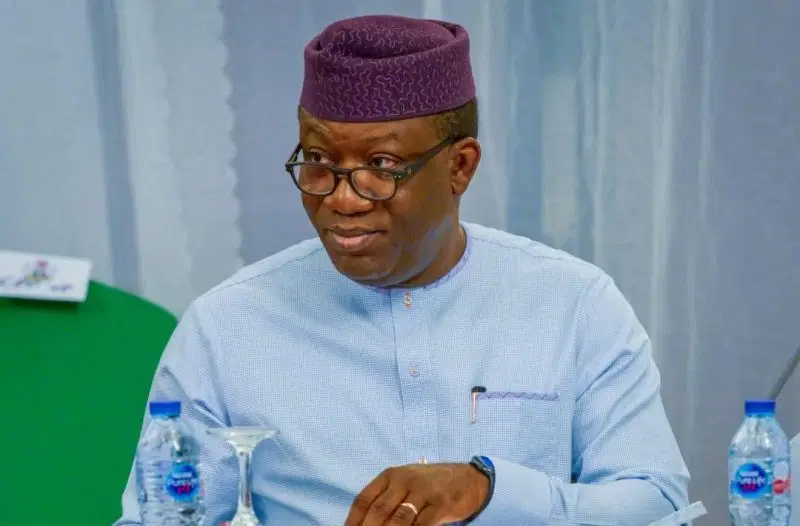
Former Ekiti State Governor and ex-Minister of Solid Minerals Development, Dr Kayode Fayemi, has described the presidential candidate of the African Democratic Congress (ADC), Atiku Abubakar’s proposal on fuel subsidy as a political strategy rather than an economic policy.
Fayemi made the remark during an interview on Arise Television’s Prime Time on Monday, while commenting on the ongoing debate over petrol subsidy and Atiku’s position on the policy.
According to Fayemi, Atiku’s proposal could be compared politically to the Muslim-Muslim presidential ticket adopted by the All Progressives Congress (APC) during the 2023 election.
“My take on that is that Atiku’s proposal of subsidy is politically equivalent to our own Muslim-Muslim ticket in 2023. It’s a political strategy. It’s not an economic construct,” Fayemi said.
He, however, acknowledged that the proposal could resonate with Nigerians struggling with the economic consequences of petrol subsidy removal.
Fayemi said vulnerable Nigerians were more concerned about their ability to meet basic needs than the technical arguments surrounding subsidy policy.
“But understandably, it’s a political strategy that will sell with those who are hard done by the impact of fuel subsidy removal,” he said.
The former governor reiterated his support for the removal of fuel subsidy, saying he had advocated the policy for several years, including during his tenure as Chairman of the Nigerian Governors’ Forum.
“I was and I remain an advocate of fuel subsidy removal. As chairman of the governors’ forum, I spent four years in this battle,” he said.
Fayemi, however, criticised the manner in which the subsidy removal was implemented by the Tinubu administration.
He said President Bola Tinubu inherited substantial groundwork on subsidy removal from the previous administration.
“What President Tinubu inherited, in fairness to him, was the work that had already been completed by that administration. The only challenge I had with it was the way it was done,” he said.
According to Fayemi, state governors had previously worked with the Federal Government and the World Bank on a safety-net strategy designed to cushion the impact of subsidy removal on vulnerable Nigerians.
He said the strategy was intended to address the needs of Nigerians who would be most affected by the policy.
Fayemi argued that the continued hardship among vulnerable Nigerians was what he believed Atiku was seeking to leverage through his subsidy proposal.
“I believe that’s what Vice President Atiku is taking advantage of. The vulnerable segment of the population is still hard done by,” he said.
The former governor said many Nigerians were less concerned about the technical aspects of subsidy policy than their ability to afford basic necessities.
“They just want to live reasonably well, eke out a living, have one or two meals a day, be able to send their kids to school, not be taken in by sickness or anything that might create further problems for them,” Fayemi said.
He also linked poverty and inequality to insecurity, arguing that the conditions were among the factors contributing to insurgency and banditry in the country.
Fayemi maintained that Atiku’s position on subsidy should therefore be viewed within the broader political contest ahead of the 2027 presidential election.
He compared the proposal to the APC’s adoption of the Muslim-Muslim ticket in 2023, arguing that both represented political calculations aimed at maximising electoral support.
While defending the principle of subsidy removal, Fayemi maintained that the impact of the policy on vulnerable Nigerians needed to be addressed through effective social protection measures.












BREAKING: Veteran Nollywood Actor Francis Duru Dies at 57

Ebola: FG Orders Nationwide Awareness Campaign After Reported Case in Abuja

Sultan of Sokoto Meets Tinubu, Prays for Peaceful Elections

NEC Endorses 90-Day Plan to Ease Cost of Living, Targets Single-Digit Inflation

JUST-IN: Tinubu Appoints Ex-DSS DG Bichi to Lead NISS Governing Board

NUJ demands justice, fair hearing and protection of press freedom in Farida Isiak’s case

Gov Sule commends DSS over arrests, ammunition recoveries in Nasarawa

FCT Teachers Resume Classes After Suspending Two-Week Strike

Plateau Indigenous Youths Reject Petition Against DSS, Accuse Fulani Groups of Orchestrating ‘Calumny’ to Halt Security Operations

Seven-Year-Old Boy Found Dead After Kidnap, N2.5m Ransom Demand in Jos
Gov Sule commends DSS over arrests, ammunition recoveries in Nasarawa
NEC Endorses 90-Day Plan to Ease Cost of Living, Targets Single-Digit Inflation

Jonathan Urges Nigeria to Boost Local Manufacturing, Reduce Imports
Seven-Year-Old Boy Found Dead After Kidnap, N2.5m Ransom Demand in Jos
FCT Teachers Resume Classes After Suspending Two-Week Strike
NUJ demands justice, fair hearing and protection of press freedom in Farida Isiak’s case
JUST-IN: Tinubu Appoints Ex-DSS DG Bichi to Lead NISS Governing Board
Plateau Indigenous Youths Reject Petition Against DSS, Accuse Fulani Groups of Orchestrating ‘Calumny’ to Halt Security Operations
Ebola: FG Orders Nationwide Awareness Campaign After Reported Case in Abuja
Sultan of Sokoto Meets Tinubu, Prays for Peaceful Elections
-
 News1 day ago
Gov Sule commends DSS over arrests, ammunition recoveries in Nasarawa
-
 National News14 hours ago
NEC Endorses 90-Day Plan to Ease Cost of Living, Targets Single-Digit Inflation
-
 News2 days ago
Jonathan Urges Nigeria to Boost Local Manufacturing, Reduce Imports
-
 News2 days ago
Seven-Year-Old Boy Found Dead After Kidnap, N2.5m Ransom Demand in Jos
-
 FCT News1 day ago
FCT Teachers Resume Classes After Suspending Two-Week Strike
-
 NUJ FCT23 hours ago
NUJ demands justice, fair hearing and protection of press freedom in Farida Isiak’s case
-
 National News14 hours ago
JUST-IN: Tinubu Appoints Ex-DSS DG Bichi to Lead NISS Governing Board
-
 NUJ FCT2 days ago
Plateau Indigenous Youths Reject Petition Against DSS, Accuse Fulani Groups of Orchestrating ‘Calumny’ to Halt Security Operations