









News
Senate passes Electoral Act Amendment Bill, dismisses claims of rejecting electronic transmission

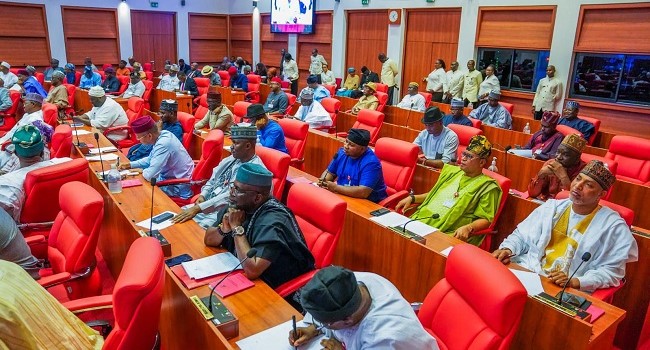
The Senate has passed the Electoral Act (Amendment) Bill, aimed at regulating the conduct of federal, state and Area Council elections in the Federal Capital Territory (FCT).
The passage of the bill came amid clarifications by the upper chamber, which dismissed media reports claiming that lawmakers rejected the electronic transmission of election results during deliberations on the legislation.
The bill was passed on Wednesday after lawmakers, sitting as the Committee of the Whole, considered it clause by clause. It was the only item on the Order Paper following a valedictory session in honour of the late Senator Okey Ezea.
In all, the Senate considered and adopted 155 clauses, with some provisions amended while the majority were retained as originally proposed.
Senate Reacts to Reports on Electronic Transmission
Following the bill’s passage after a marathon session lasting about four and a half hours, Senate President Godswill Akpabio addressed reports suggesting that the Senate voted against the mandatory electronic transmission of election results.
Consideration of the controversial Clause 60, Subsection 3, began at about 2:00pm and lasted until 6:26pm, sparking widespread speculation online that lawmakers had rejected compulsory electronic upload of results to the INEC Result Viewing (IREV) portal.
Some reports claimed that the Senate discarded a proposal that would have compelled presiding officers of the Independent National Electoral Commission (INEC) to transmit polling unit results electronically in real time after signing and stamping the prescribed result forms.
Instead, the reports said the Senate retained the existing provision of the Electoral Act, which states that “the presiding officer shall transfer the results, including the total number of accredited voters and the results of the ballot, in a manner as prescribed by the Commission.”
‘We Did Not Reject Electronic Transmission’ — Akpabio
Reacting, Akpabio described the interpretation as misleading, insisting that the Senate did not remove electronic transmission from the law.
“Distinguished colleagues, the social media is already awash with reports that the Senate has literally rejected electronic transmission of results. That is not true,” Akpabio said.
“What we did was to retain the electronic transmission which has been in the Act and was used in 2022.
“So please, do not allow people to confuse you. If you are in doubt, we will make our final votes and proceedings available to you if you apply.”
He stressed that under his leadership, the Senate had no intention of reversing electoral reforms.
“This Senate under my watch has not rejected the electronic transmission of results. It is in my interest as a participant in the next election for such to be done.
“We have retained what was in the previous provision by way of amendment. That provision already allows for electronic transmission. So it is still part of our law. We cannot afford to go backwards,” he added.
Ongoing Debate Over Electoral Reforms
The issue of electronic transmission of results has remained one of the most contentious aspects of Nigeria’s electoral reforms since the 2023 general elections, with civil society organisations and opposition parties repeatedly calling for clearer and more explicit legal backing to enhance transparency and public confidence in the electoral process.
Akpabio said his clarification was aimed at calming public concerns and correcting what he described as deliberate or careless misrepresentation of the Senate’s actions as the National Assembly continues work on electoral reforms ahead of future elections.

















News56 minutes ago
Court delays ruling on El-Rufai’s bail, fixes March 31 for hearing

News1 hour ago
BREAKING: EFCC operatives storm Malami’s Abuja residence, seal off street

News4 hours ago
Dangote warns Middle East tensions could force Nigerians into work-from-home mode

News4 hours ago
APC leadership move to affirm Tinubu as sole Presidential candidate for 2027

News4 hours ago
Gov Soludo appoints Chiamaka Nnake as first female SSG

News4 hours ago
BREAKING: El-Rufai arrives Court for arraignment under tight security

News5 hours ago
Phenomenal People Magazine publisher celebrates NUJ FCT Chairman Grace Ike on birthday

News18 hours ago
Makinde holds PDP stakeholders meeting ahead of 2027 elections

World News18 hours ago
Iran says it received U.S. messages on ending war

News20 hours ago
DSS storms Malami’s Abuja residence after Atiku’s visit

News1 day ago
Police promise justice as 16 arrested over Ozoro festival violence

National News1 day ago
Restructuring: Police clarify IGP directive, deny disbandment of tactical units

News1 day ago
Nigerian Army neutralises dozens of bandits in Bello Turji’s camp

National News2 days ago
FG to scrap Common Entrance, introduce Learner ID for pupils

News2 days ago
Panic in Kwara as gunmen invade Church, kidnap worshippers

News20 hours ago
FG set to launch HIV prevention injection as 52,000 doses arrive

World News1 day ago
Israel-Iran conflict deepens as global energy crisis worsens
News5 hours ago
Phenomenal People Magazine publisher celebrates NUJ FCT Chairman Grace Ike on birthday

National News1 day ago
NGF submits State Police framework to NSA, eyes National Assembly review

News1 day ago
BREAKING: Former Acting Accountant-General sentenced to 72 Years for N868 Million fraud
-
 News1 day ago
Police promise justice as 16 arrested over Ozoro festival violence
-
 National News1 day ago
Restructuring: Police clarify IGP directive, deny disbandment of tactical units
-
 News1 day ago
Nigerian Army neutralises dozens of bandits in Bello Turji’s camp
-
 National News2 days ago
FG to scrap Common Entrance, introduce Learner ID for pupils
-
 News2 days ago
Panic in Kwara as gunmen invade Church, kidnap worshippers
-
 News20 hours ago
FG set to launch HIV prevention injection as 52,000 doses arrive
-
 World News1 day ago
Israel-Iran conflict deepens as global energy crisis worsens
-
 News5 hours ago
Phenomenal People Magazine publisher celebrates NUJ FCT Chairman Grace Ike on birthday