








Feature
How Akpabio’s leadership secured Nigeria’s electoral future

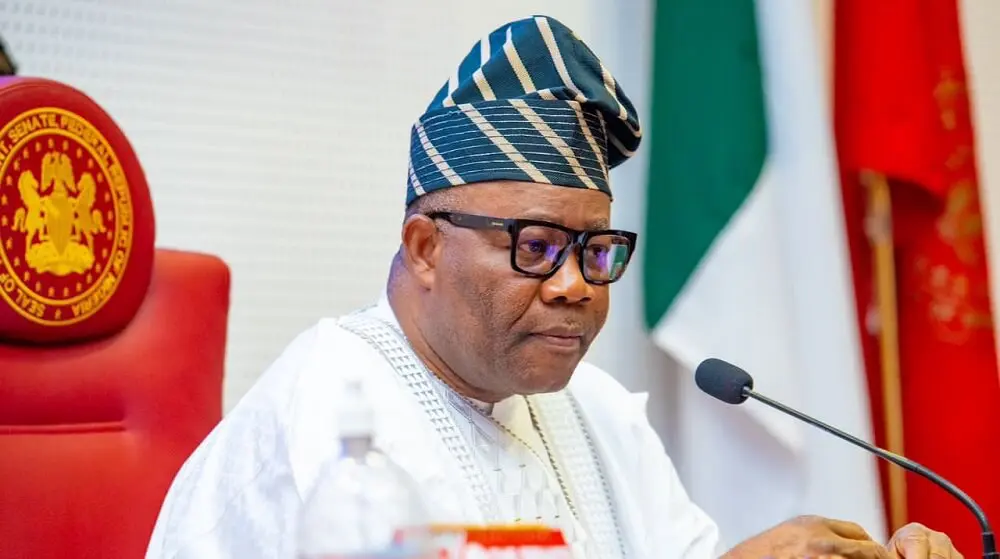
By Rt Hon Eseme Eyiboh mnipr
In the evolving story of Nigeria’s democratic consolidation, few issues have provoked as much intensity as electoral reform. The signing into law of the Electoral Act (Repeal and Re-enactment) Bill 2026 by President Bola Ahmed Tinubu marked another chapter in this journey, drawing applause, skepticism, and fierce debate in equal measure.
At the centre of this moment stands Godswill Akpabio, President of the Senate, who has consistently articulated a position that blends institutional caution with reformist intent. His assertion that the National Assembly met “the aspirations of Nigerians, not a few people who make noise” reflects not merely rhetorical flourish, but a deeper philosophy of lawmaking anchored in constitutionalism, legislative procedure, and national peculiarities.
To understand Akpabio’s positioning, one must situate the reform within Nigeria’s broader democratic trajectory. Since the country’s return to civilian rule in 1999, electoral reforms have often oscillated between technological optimism and structural reality. The 2026 re-enactment does not discard innovation; rather, it recalibrates it. In defending the new Act, Akpabio emphasized that the National Assembly undertook a “painstaking” and “thorough” process, mindful of the country’s infrastructural limitations, judicial precedents, and the ultimate objective of preventing disenfranchisement.
A key flashpoint in the debate was the question of electronic transmission of results. For many reform advocates, real-time electronic transmission became symbolic of transparency. Yet Akpabio’s argument was not against technology; it was against rigidity detached from capacity. He consistently maintained that technology must serve democracy, not endanger it. In a country where broadband penetration is uneven, where insecurity disrupts network infrastructure across multiple states, and where power supply remains inconsistent, embedding inflexible “real-time” mandates into statute could, in his view, expose elections to avoidable litigations and invalidation.
This perspective aligns with the constitutional role of the legislature. The Senate does not conduct elections; it makes laws. The responsibility for operational modalities rests with the Independent National Electoral Commission (INEC), which applies the law within its administrative and technical capacity. By leaving room for INEC to determine timing and modalities of transmission, the Act reflects a respect for institutional boundaries. Akpabio’s defense of this approach underscores his insistence that Parliament legislate for posterity, not for transient political advantage.
At the State House signing ceremony, President Tinubu reinforced this institutional clarity. He observed that Nigeria’s elections remain “essentially manual.” Ballots are cast manually, counted manually, and declared by human beings. While electronic viewing enhances transparency, the core process remains human-centered. Tinubu’s caution about broadband readiness and cyber vulnerabilities echoes Akpabio’s reasoning. Together, their statements project a governance philosophy that privileges clarity and feasibility over performative reform.
Perhaps the most celebrated innovation in the new Act is the formal legal recognition of the Bimodal Voter Accreditation System (BVAS) result viewer, commonly referred to as IReV. This recognition represents a significant milestone. For the first time since independence in 1960, electronic viewing of polling unit results is explicitly grounded in statutory authority. Under the amended framework, results transmitted electronically—even if delayed due to connectivity issues—must ultimately reflect on the IReV portal once network is restored. This creates a verifiable digital trail that citizens, observers, and parties can scrutinize and interrogate.
Akpabio described this as a landmark safeguard against a historic problem: tampering between polling units and collation centres. By ensuring that Form EC8A—the primary polling unit result form signed by presiding officers and party agents—feeds into a publicly accessible portal, the law strengthens accountability without discarding manual collation procedures validated by courts.
The Supreme Court’s pronouncements in post-2023 election litigation had clarified that IReV, as previously configured, was not the definitive legal record of results. Rather than ignore this judicial interpretation, the legislature responded by integrating electronic viewing into statutory text while preserving the evidentiary primacy of signed result forms. This harmonization of law and jurisprudence illustrates legislative maturity.
Critics, including the opposition parties, alleged that the Act’s signing reflected partisan fear. Civil society voices such as Yiaga Africa described the reform as incremental where transformation was needed. Yet even among critics, a pragmatic thread emerged.
The Civil Society Legislative Advocacy Centre and the Transition Monitoring Group urged acceptance of the law while focusing attention on demanding credible conduct from INEC. This convergence suggests that while disagreements persist about optimal reform design, there is recognition that institutional strengthening is iterative.
Akpabio’s stance during earlier debates further illuminates his approach. On February 8, at a public presentation of Senator Effiong Bob’s book in Abuja, he cautioned against hasty conclusions about an amendment process still underway. His insistence that commentators wait until Votes and Proceedings were finalized before passing judgment reflects a proceduralist ethos.
Legislative drafting is iterative. Clauses are debated, amended, harmonized between chambers, and only then crystallized into final text. By defending this process against what he termed premature media trials, Akpabio positioned himself as a guardian of institutional integrity.
His critique of “retreat politics” is equally telling. Consultative retreats, he argued, are valuable but not binding. Final authority rests on the Senate floor, where clauses are debated and voted upon. This distinction reinforces parliamentary sovereignty within Nigeria’s constitutional framework. It also shows a deeper democratic principle: advocacy informs lawmaking, but elected representatives deliberate and decide.
Another noteworthy provision in the amended Act concerns internal party democracy. By empowering party members to vote directly for candidates during primaries, the law dilutes the dominance of small delegate blocs. In theory, this broadens participation, reduces transactional politics, and enhances legitimacy. Akpabio’s highlighting of this reform signals an understanding that electoral integrity begins within parties, not merely at polling units.
The Act also addresses scenarios where leading candidates are disqualified by courts. By mandating fresh elections in such circumstances, it prevents outcomes where significantly lower-polling candidates assume office by default. This provision closes a loophole that had generated controversy in past cycles. In doing so, the legislature strengthens the moral authority of electoral outcomes.
The reduction of statutory notice for elections from 360 days to 300 days, may appear technical but carries practical implications. It allows scheduling flexibility, including the possibility of avoiding sensitive religious periods such as Ramadan and Lent. This demonstrates legislative sensitivity to socio-cultural realities—a recurring theme in Akpabio’s rhetoric about Nigeria’s peculiarities.
Opposition criticisms deserve engagement. The PDP characterized the signing as hurried and partisan. Yet the legislative timeline reflects deliberation across chambers, conference committee harmonization, and eventual executive assent. Moreover, the principle of the legislative-executive cooperation is intrinsic to constitutional governance. The swift assent by President Tinubu can be interpreted not as haste but as responsiveness to parliamentary consensus.
Support from figures like Nyesom Wike reinforces the perception that the reform commands cross-sectional backing within the governing architecture. Wike’s description of democracy as a “work-in-progress” aligns with Akpabio’s incrementalist philosophy. Reform, in this view, is evolutionary rather than revolutionary.
Central to Akpabio’s defense is the rejection of absolutism. Mandating real-time electronic transmission in a context of infrastructural fragility could render entire states’ results vulnerable to nullification due to network outages. He invoked comparative examples, including electoral disputes in advanced democracies, to illustrate that even technologically sophisticated systems encounter anomalies. The lesson he draws is humility: laws must anticipate worst-case scenarios.
This caution is not synonymous with conservatism. By embedding IReV recognition in statute, the Act advances transparency beyond previous frameworks. It creates a hybrid model—manual voting and collation complemented by electronic visibility. Such hybridity may represent a uniquely Nigerian pathway, blending global best practices with domestic constraints.
Akpabio’s rhetorical framing—distinguishing “noise” from lawmaking—has attracted attention. While critics may interpret it as dismissive, it also speaks to a tension in contemporary democracies: the amplification of vocal minorities through media ecosystems. Legislative legitimacy, however, derives from electoral mandate and constitutional procedure. By emphasizing the “generality of Nigerians,” Akpabio situates himself within a majoritarian democratic theory tempered by rule of law.
The question of disenfranchisement further illuminates his position. If technological failure in insecure or rural areas invalidated results, marginalized communities could bear disproportionate impact. By allowing delayed electronic uploads once connectivity is restored, the Act seeks to reconcile inclusivity with transparency. This compromise reflects distributive sensitivity.
In evaluating Akpabio’s stewardship, one must also consider his broader legislative philosophy. He repeatedly asserts that laws must outlast individuals. This intergenerational perspective discourages tailoring statutes to immediate partisan contests. Whether one agrees with every clause, the emphasis on durability highlights a statesmanlike orientation.
The reactions from civil society, though critical, implicitly acknowledge the dynamic nature of reform. Calls to continue advocating improvements indicate that the 2026 Act is part of an ongoing process. Akpabio himself has stated that doors remain open. This openness suggests confidence rather than defensiveness.
Ultimately, the measure of electoral reform lies not only in statutory text but in implementation. INEC’s capacity, political party behavior, judicial adjudication, and citizen vigilance will shape outcomes. Yet legislation provides the framework within which these actors operate. By integrating electronic viewing, clarifying collation hierarchies, strengthening internal party democracy, and closing disqualification loopholes, the National Assembly has recalibrated that framework.
In positioning Akpabio in a favorable light, it is important to avoid hagiography. Democratic leadership entails contestation. However, his consistent themes—respect for process, infrastructural realism, institutional boundaries, and posterity—form a coherent narrative. Rather than capitulate to populist maximalism or resist reform altogether, he charted a middle course.
Nigeria’s democracy, like many across the globe, navigates between aspiration and capacity. Technological for determinism offers seductive simplicity; constitutional prudence demands complexity. In the crucible of electoral reform, Akpabio has presented himself as a custodian of that prudence. Whether history ultimately vindicates every provision of the 2026 Act will depend on future elections. But as of its enactment, the legislative record reflects a deliberate attempt to harmonize innovation with stability.
The broader democratic project requires precisely this balance. Transparency without feasibility breeds litigation. Feasibility without transparency breeds distrust. By embedding electronic visibility within a manual backbone, the Act seeks equilibrium. In championing this architecture, Akpabio aligns himself with a vision of reform that is incremental yet substantive, cautious yet forward-moving.
As Nigeria approaches future electoral cycles, the real test will be whether citizens experience greater confidence, fewer disputes, and clearer outcomes. Should that occur, the painstaking deliberations defended by the Senate President may be remembered not as noise, but as necessary groundwork. In that sense, Akpabio’s insistence that lawmaking differ from clamor may prove less a rebuke than a reminder: democracy flourishes not only through passion, but through patient construction of rules capable of enduring the storms of politics. Nigeria’s Electoral Future shall have Senator Godswill Akpabio positively mentioned in its repository.
Rt Hon Eseme Eyiboh mnipr
Special Adviser on Media/Publicity and official Spokesperson to the President of the Senate







News3 hours ago
Storm wrecks Kugbo bus terminal months after commissioning, triggers Abuja gridlock

News3 hours ago
ADC Crisis deepens as Kachikwu’s faction backs INEC, disowns Mark, Gombe

News3 hours ago
Police must uphold integrity, Disu charges officers at National Police Day

Entertainment3 hours ago
Cancer survivor accuses Blessing CEO of using altered medical report without consent

News3 hours ago
Passion of Christ actor killed by firework during church rehearsal in Cross River

FCT News3 hours ago
FCT Minister orders arrest of developer, seizure of land after Abuja hotel collapse

News6 hours ago
NAFDAC moves to cut salt in foods as Nigeria battles rising hypertension cases

News9 hours ago
Yusuf Buhari declares 2027 House of Representatives bid

World News10 hours ago
Artemis 2 crew sets new human distance record from earth on historic Lunar Flyby

News13 hours ago
BREAKING: Kebbi Assembly Speaker Muhammad Zuru dies after illness in Egypt

News1 day ago
NUJ demands apology from Wike over comment on Journalist Seun Okinbaloye

News1 day ago
ADC coalition ‘no threat’ to APC — Felix Morka

News1 day ago
Cleric distributes rice to members at Easter, preaches love

News1 day ago
Stray bullet from soldiers’ celebration kills teenager in Maiduguri

News1 day ago
Easter: NSIFT boss Faleye felicitates staff, commends dedication to duty
News13 hours ago
BREAKING: Kebbi Assembly Speaker Muhammad Zuru dies after illness in Egypt

News1 day ago
Arteta rallies Arsenal after shock defeats ahead of Champions League clash
News3 hours ago
Passion of Christ actor killed by firework during church rehearsal in Cross River
News1 day ago
ADC raises alarm over INEC stance, warns of possible exclusion from 2027 elections
FCT News3 hours ago
FCT Minister orders arrest of developer, seizure of land after Abuja hotel collapse
-
 News1 day ago
NUJ demands apology from Wike over comment on Journalist Seun Okinbaloye
-
 News1 day ago
ADC coalition ‘no threat’ to APC — Felix Morka
-
 News1 day ago
Cleric distributes rice to members at Easter, preaches love
-
 News1 day ago
Stray bullet from soldiers’ celebration kills teenager in Maiduguri
-
 News1 day ago
Easter: NSIFT boss Faleye felicitates staff, commends dedication to duty
-
 News13 hours ago
BREAKING: Kebbi Assembly Speaker Muhammad Zuru dies after illness in Egypt
-
 News1 day ago
Arteta rallies Arsenal after shock defeats ahead of Champions League clash
-
 News3 hours ago
Passion of Christ actor killed by firework during church rehearsal in Cross River