
Business
Nigeria’s balance of payments surplus drops 38% amid oil revenue decline, investment shifts

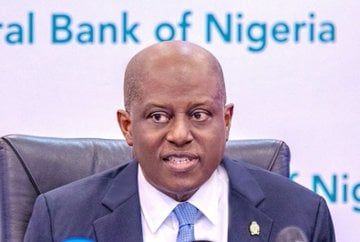
Nigeria’s external sector came under pressure in 2025, as the country’s Balance of Payments (BOP) surplus declined sharply by 38.1 per cent to $4.23 billion, down from $6.83 billion recorded in 2024.
Provisional data released by the Central Bank of Nigeria (CBN) highlights a mixed economic outlook, with falling crude oil earnings and a significant drop in foreign portfolio investments outweighing gains recorded in gas exports and refined petroleum shipments.
The current account remained in surplus but weakened considerably, dropping by 26.2 per cent to $14.04 billion from $19.03 billion in the previous year. The decline was largely driven by a 14.4 per cent fall in crude oil exports, which dropped to $31.54 billion.
Despite this, gas exports recorded strong growth, rising by 21.4 per cent to $10.51 billion. The goods account also posted a higher surplus of $14.51 billion, supported by increased refined petroleum exports.
A key contributor to this growth was the Dangote Refinery, which generated $6.13 billion in refined product exports and helped reduce fuel imports by 28.9 per cent to $10.00 billion.
On the financial side, Nigeria experienced a major shift, moving from a net lending position of $9.65 billion in 2024 to a net borrowing position of $1.69 billion in 2025. This was largely due to a sharp 48.3 per cent decline in foreign portfolio investment inflows, which fell to $8.04 billion.
In contrast, foreign direct investment showed strong recovery, surging by 149.1 per cent to $4.01 billion, reflecting increased confidence among long-term investors, particularly in equity investments and reinvested earnings.
However, rising outflows in services and income payments further pressured the external sector. The services account deficit widened to $14.58 billion, driven by higher spending on travel, transport, and insurance.
Net outflows in the primary income account also rose significantly by 60.9 per cent to $9.09 billion, largely due to increased dividend and interest payments to foreign investors.
Despite these challenges, Nigeria’s external reserves grew by 13.8 per cent to $45.75 billion, providing a buffer against ongoing economic pressures.
Overall, the data underscores the shifting dynamics in Nigeria’s external sector, with declining oil revenues, rising non-oil contributions, and changing investment patterns shaping the country’s economic outlook.













Ebola Patient in Nigeria Is Wife of Swiss Diplomat, Switzerland Says

Uba Sani Vows Massive Kaduna Support for Tinubu Ahead of 2027 Election

Atiku Asks Tinubu to Identify Those Behind Alleged Ministerial Appointment Bribes

One Dead, Three Rescued After Two-Storey Building Collapses in Lagos

CBN grants JPMorgan approval-in-principle to establish Merchant Bank in Nigeria

BREAKING: Veteran Nollywood Actor Francis Duru Dies at 57

Ebola: FG Orders Nationwide Awareness Campaign After Reported Case in Abuja

Sultan of Sokoto Meets Tinubu, Prays for Peaceful Elections

NEC Endorses 90-Day Plan to Ease Cost of Living, Targets Single-Digit Inflation

JUST-IN: Tinubu Appoints Ex-DSS DG Bichi to Lead NISS Governing Board

Gov Sule commends DSS over arrests, ammunition recoveries in Nasarawa

FCT Teachers Resume Classes After Suspending Two-Week Strike

NUJ demands justice, fair hearing and protection of press freedom in Farida Isiak’s case
JUST-IN: Tinubu Appoints Ex-DSS DG Bichi to Lead NISS Governing Board
NEC Endorses 90-Day Plan to Ease Cost of Living, Targets Single-Digit Inflation
Ebola: FG Orders Nationwide Awareness Campaign After Reported Case in Abuja
Sultan of Sokoto Meets Tinubu, Prays for Peaceful Elections
BREAKING: Veteran Nollywood Actor Francis Duru Dies at 57
CBN grants JPMorgan approval-in-principle to establish Merchant Bank in Nigeria
Atiku Asks Tinubu to Identify Those Behind Alleged Ministerial Appointment Bribes
-
 News2 days ago
Gov Sule commends DSS over arrests, ammunition recoveries in Nasarawa
-
 FCT News2 days ago
FCT Teachers Resume Classes After Suspending Two-Week Strike
-
 NUJ FCT2 days ago
NUJ demands justice, fair hearing and protection of press freedom in Farida Isiak’s case
-
 National News1 day ago
JUST-IN: Tinubu Appoints Ex-DSS DG Bichi to Lead NISS Governing Board
-
 National News1 day ago
NEC Endorses 90-Day Plan to Ease Cost of Living, Targets Single-Digit Inflation
-
 National News1 day ago
Ebola: FG Orders Nationwide Awareness Campaign After Reported Case in Abuja
-
 National News1 day ago
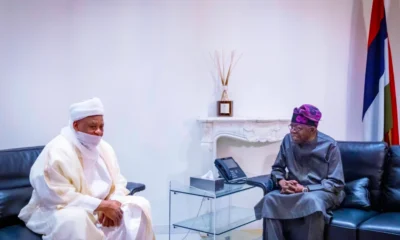
Sultan of Sokoto Meets Tinubu, Prays for Peaceful Elections
-
 Entertainment1 day ago
BREAKING: Veteran Nollywood Actor Francis Duru Dies at 57