
National News
Senate passes Electoral Act Re-Enactment Bill after clause 60 clash

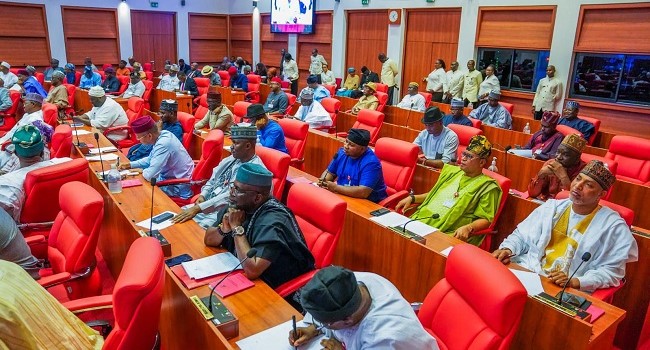
The Nigerian Senate on Tuesday passed the Electoral Act, 2022 (Repeal and Re-Enactment) Bill 2026, following a tense and rowdy session triggered by disagreements over Clause 60 of the proposed legislation.
Proceedings became heated when Senator Enyinnaya Abaribe (ADC/Abia South) demanded a division on Clause 60(3), particularly the proviso allowing manual transmission of election results in the event of electronic transmission failure.
Senate President Godswill Akpabio initially suggested that the demand had earlier been withdrawn, prompting immediate objections from opposition lawmakers. Citing Order 52(6) of the Senate Standing Orders, Deputy Senate President Barau Jibrin argued that it would be out of order to revisit a matter already ruled upon by the presiding officer.
The submission sparked another uproar, with a brief face-off between Senator Sunday Karimi and Abaribe. Senate Leader Opeyemi Bamidele reminded lawmakers that he had sponsored the motion for rescission of the earlier amendment, meaning previous decisions were no longer binding.
Akpabio later suggested that Abaribe’s insistence on division was aimed at publicly demonstrating his position. After sustaining the point of order, the Senate President allowed Abaribe to formally move his motion under Order 72(1).
Abaribe called for a division on Clause 60(3), seeking the removal of the proviso that permits manual transmission of results where electronic transmission fails, and arguing that Form EC8A should not serve as the fallback basis.
During the division, senators who supported retaining the proviso were asked to stand, followed by those opposed. Fifteen opposition senators stood against the caveat, while 55 senators voted in support of retaining it, according to the count announced by the Senate President.
Earlier, the chamber had rescinded its previous passage of the bill to address technical inconsistencies and concerns relating to the timing of the 2027 general elections.
Bamidele explained that the decision followed the announcement by the Independent National Electoral Commission (INEC) fixing the 2027 general elections for February 2027 after consultations with National Assembly leadership.
He noted that the 360-day notice requirement under Clause 28 could result in the scheduling of elections during the Ramadan period, potentially affecting voter turnout, logistics and inclusiveness. Lawmakers also identified discrepancies in the Long Title and multiple clauses, including cross-referencing, numbering and internal consistency issues.
Following clause-by-clause consideration and resolution of contentious provisions, the Senate proceeded to pass the Electoral Act, 2022 (Repeal and Re-Enactment) Bill 2026, setting the stage for further legislative processes ahead of the 2027 general elections.







Kogi AGILE moves to strengthen digital literacy as project opens bids for education intervention

Kogi Govt reaffirms commitment to Girls’ Education, vows to tackle Child Marriage

NSITF Boss Seeks Stronger Inter-Agency Collaboration to Improve Workers’ Welfare

Chinese Ambassador Outlines Four-Point Plan for China-Africa Mining Cooperation

2027: Cross River APC names Stephen Odey DG of campaign

NSA Directorate seeks NUJ partnership to curb misinformation, protect critical infrastructure

AFP to storm Made By Design Expo 2026 with new designs

Peller announces plans to host Wole Soyinka on livestream

Indonesia seeks Nigerian investment in renewable energy, manufacturing, agriculture

UBEC warns states as $552m Education programme targets 29 Million children
UBEC warns states as $552m Education programme targets 29 Million children

IMF urges Nigeria to reject broad petrol subsidy, recommends targeted relief
Indonesia seeks Nigerian investment in renewable energy, manufacturing, agriculture

Zenith Bank Champions Girl-child Empowerment, Equips 300 Schoolgirls For The Future
Peller announces plans to host Wole Soyinka on livestream

Atiku accuses Tinubu of making life expensive, promises affordable living
NSA Directorate seeks NUJ partnership to curb misinformation, protect critical infrastructure
Chinese Ambassador Outlines Four-Point Plan for China-Africa Mining Cooperation
AFP to storm Made By Design Expo 2026 with new designs
2027: Cross River APC names Stephen Odey DG of campaign
-
 News1 day ago
UBEC warns states as $552m Education programme targets 29 Million children
-
 News1 day ago
IMF urges Nigeria to reject broad petrol subsidy, recommends targeted relief
-
 National News1 day ago
Indonesia seeks Nigerian investment in renewable energy, manufacturing, agriculture
-
 Business1 day ago
Zenith Bank Champions Girl-child Empowerment, Equips 300 Schoolgirls For The Future
-
 Entertainment1 day ago
Peller announces plans to host Wole Soyinka on livestream
-
 News1 day ago
Atiku accuses Tinubu of making life expensive, promises affordable living
-
 News1 day ago
AFP to storm Made By Design Expo 2026 with new designs
-
 News24 hours ago
NSA Directorate seeks NUJ partnership to curb misinformation, protect critical infrastructure