








News
FG seeks stronger federal–state collaboration to commercialize scientific research in Nigeria

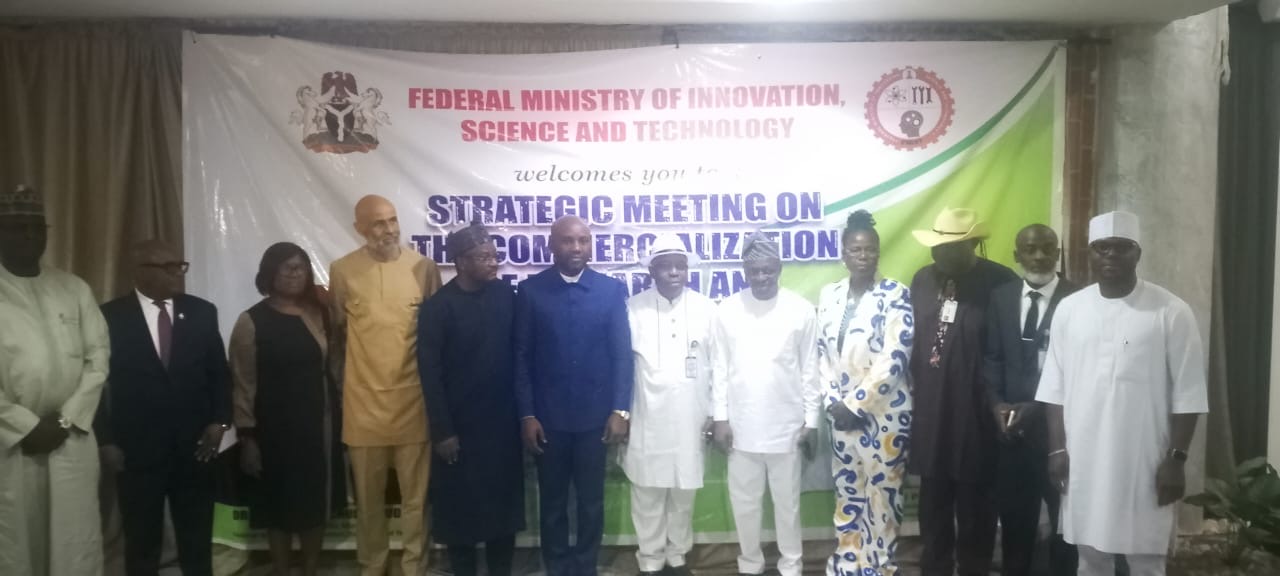
The Federal Government has intensified efforts to transform scientific research in Nigeria into commercially viable products and enterprises, as stakeholders gathered in Abuja for a strategic meeting on the commercialisation of research outcomes.
The meeting, convened by the Federal Ministry of Innovation, Science and Technology, brought together state Commissioners for Science, Technology and Innovation (STI), heads of agencies, and industry stakeholders to chart a roadmap for converting research findings into economic value.
Delivering the keynote address, the Minister of Innovation, Science and Technology, Dr. Kingsley Tochukwu Udeh, said Nigeria must move beyond producing academic research to converting knowledge into products, services and businesses that can drive national development.
He noted that despite significant investments in research and development across universities, polytechnics and research institutes, many innovations remain unused.
“Too many valuable research outputs remain on laboratory shelves, in technical reports, or in academic journals without translating into products, services, or enterprises that can transform lives,” the minister said.
According to him, countries that dominate the global economy are those that have mastered the commercialization of scientific discoveries.
“Economic power today is defined not just by natural resources but by the ability to convert knowledge into value. Nigeria must bridge the gap between research outputs and market outcomes,” he added.
Dr. Udeh announced the establishment of a committee to develop a National Policy on Commercialization of Research and Development Results and Inventions, which will serve as a blueprint to coordinate efforts between federal and state governments.
He stressed that state governments play a critical role in building innovation ecosystems, noting that industries, startups and research institutions operate largely at the sub-national level.
“Innovation ecosystems are built not only at the federal level but within states where industries operate, SMEs grow and local economies evolve,” he said.
The minister also called for innovative funding models to support research commercialization, including Public–Private Partnerships (PPPs), venture capital investment, state-level innovation funds and industry-sponsored research programmes.
“Public funding alone cannot drive this transformation. We must explore partnerships and create investor confidence through transparency, regulatory clarity and protection of intellectual property,” he stated.
Earlier in his welcome remarks, the Permanent Secretary of the ministry, Mr. Philip Ndiomu Ebiogeh, emphasized the need to convert research knowledge into economic value.
“Nigeria cannot afford to remain a nation where research findings gather dust on shelves. We must deliberately build systems that support patenting, prototyping, incubation, venture financing and market access,” Ebiogeh said.
He noted that state commissioners occupy a strategic position in bridging the gap between laboratory discoveries and industrial application because of their proximity to local innovation ecosystems.
The Director-General of the National Board for Technology Incubation (NBTI), Dr. Kazeem Kolawole Raji, also highlighted ongoing initiatives to nurture young innovators, including the NextGen Innovation Challenge, which encourages Nigerian youths to develop business-driven innovations.
Dr. Raji disclosed that the competition attracted about 3,000 innovative entries within three weeks last year, while over 1,000 applications have already been received for the 2026 edition.
“Our goal is to ensure that Nigerian youths become employers of labour. If each innovation creates jobs for 20 or 30 people, imagine the multiplier effect on employment and GDP,” he said.
He added that the programme adopts a technology readiness level framework to assess innovations and eliminate bureaucratic bottlenecks that often hinder young innovators.
Meanwhile, the Commissioner for Innovation, Science and Technology in Kogi State, Dr. Helen Adeniyi, commended the federal government for convening the meeting and pledged the state’s continued collaboration.
“We have the human capability, the political will and the natural resources to leverage innovation. Kogi State will continue to work with the federal ministry to support initiatives that promote research commercialization,” she said.
The strategic meeting is expected to produce a national roadmap with timelines, responsibilities and measurable targets aimed at strengthening Nigeria’s innovation ecosystem, boosting local manufacturing and creating sustainable jobs.
Dr. Udeh urged stakeholders to ensure that the discussions translate into concrete actions.
“Let us move from potential to performance, from ideas to industry, and from research to revenue,” the minister said.





News14 minutes ago
IGP Disu removes Benjamin Hundeyin as Force PRO

News16 minutes ago
FG seeks stronger federal–state collaboration to commercialize scientific research in Nigeria

Sports17 minutes ago
CAF postpones 2026 WAFCON in Morocco weeks before kick-off

Sports18 minutes ago
Sen. Seriake Dickson dumps PDP, joins newly registered NDC

News5 hours ago
JUST IN: Kano Assembly moves to impeach Deputy Governor Abdussalam Gwarzo

News5 hours ago
Court acquits Abba Kyari of 23-count asset non-declaration case

Metro6 hours ago
Nigerian Army kills notorious kidnapper, rescues four in Edo forest

World News6 hours ago
Azerbaijan summons Iranian envoy after drone strikes injure civilians

Metro6 hours ago
Gunmen kill two Police Officers, burn checkpoint in Kebbi

Sports6 hours ago
Hurzeler slams Arsenal tactics after narrow Brighton defeat

News2 days ago
China-Nigeria Women’s Carnival strengthens cultural ties at Lantern Festival in Abuja

News1 day ago
Man murders brother for allegedly ‘shooting him’ in a dream

NUJ FCT2 days ago
NUJ FCT Chairman Grace Ike congratulates Publisher Phenomenal People Magazine Evelyn Onyilo on her Birthday

National News2 days ago
JRB bans roadblocks for tax collection, unveils new presumptive tax rules

World News1 day ago
Macron backs Spain amid Trump’s trade threats

Sports1 day ago
Barcelona to miss Kounde, Balde in Champions League last 16

News2 days ago
Electoral Reform Act: Group calls for immediate amendment to protect real-time results transmission

News1 day ago
Gov Yusuf’s ally Umar Doguwa emerges APC chairman in Kano

World News1 day ago
Russian strikes kill civilians in Ukraine, including passenger train attack

News1 day ago
BREAKING: Tinubu swears in Tunji Disu as 23rd Inspector-General of Police
-
 News2 days ago
China-Nigeria Women’s Carnival strengthens cultural ties at Lantern Festival in Abuja
-
 News1 day ago
Man murders brother for allegedly ‘shooting him’ in a dream
-
 NUJ FCT2 days ago
NUJ FCT Chairman Grace Ike congratulates Publisher Phenomenal People Magazine Evelyn Onyilo on her Birthday
-
 National News2 days ago
JRB bans roadblocks for tax collection, unveils new presumptive tax rules
-
 World News1 day ago
Macron backs Spain amid Trump’s trade threats
-
 World News1 day ago
Russian strikes kill civilians in Ukraine, including passenger train attack
-
 Sports1 day ago
Barcelona to miss Kounde, Balde in Champions League last 16
-
 News2 days ago
Electoral Reform Act: Group calls for immediate amendment to protect real-time results transmission