






National News
Senate passes Electoral Act Re-Enactment Bill after clause 60 clash

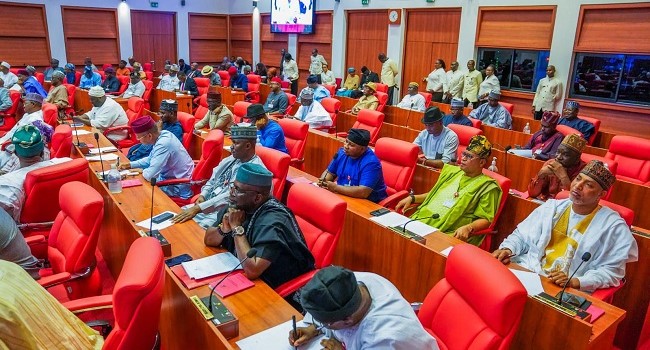
The Nigerian Senate on Tuesday passed the Electoral Act, 2022 (Repeal and Re-Enactment) Bill 2026, following a tense and rowdy session triggered by disagreements over Clause 60 of the proposed legislation.
Proceedings became heated when Senator Enyinnaya Abaribe (ADC/Abia South) demanded a division on Clause 60(3), particularly the proviso allowing manual transmission of election results in the event of electronic transmission failure.
Senate President Godswill Akpabio initially suggested that the demand had earlier been withdrawn, prompting immediate objections from opposition lawmakers. Citing Order 52(6) of the Senate Standing Orders, Deputy Senate President Barau Jibrin argued that it would be out of order to revisit a matter already ruled upon by the presiding officer.
The submission sparked another uproar, with a brief face-off between Senator Sunday Karimi and Abaribe. Senate Leader Opeyemi Bamidele reminded lawmakers that he had sponsored the motion for rescission of the earlier amendment, meaning previous decisions were no longer binding.
Akpabio later suggested that Abaribe’s insistence on division was aimed at publicly demonstrating his position. After sustaining the point of order, the Senate President allowed Abaribe to formally move his motion under Order 72(1).
Abaribe called for a division on Clause 60(3), seeking the removal of the proviso that permits manual transmission of results where electronic transmission fails, and arguing that Form EC8A should not serve as the fallback basis.
During the division, senators who supported retaining the proviso were asked to stand, followed by those opposed. Fifteen opposition senators stood against the caveat, while 55 senators voted in support of retaining it, according to the count announced by the Senate President.
Earlier, the chamber had rescinded its previous passage of the bill to address technical inconsistencies and concerns relating to the timing of the 2027 general elections.
Bamidele explained that the decision followed the announcement by the Independent National Electoral Commission (INEC) fixing the 2027 general elections for February 2027 after consultations with National Assembly leadership.
He noted that the 360-day notice requirement under Clause 28 could result in the scheduling of elections during the Ramadan period, potentially affecting voter turnout, logistics and inclusiveness. Lawmakers also identified discrepancies in the Long Title and multiple clauses, including cross-referencing, numbering and internal consistency issues.
Following clause-by-clause consideration and resolution of contentious provisions, the Senate proceeded to pass the Electoral Act, 2022 (Repeal and Re-Enactment) Bill 2026, setting the stage for further legislative processes ahead of the 2027 general elections.







News56 minutes ago
ADC raises alarm over INEC stance, warns of possible exclusion from 2027 elections

News7 hours ago
NUJ demands apology from Wike over comment on Journalist Seun Okinbaloye

News7 hours ago
Stray bullet from soldiers’ celebration kills teenager in Maiduguri

News10 hours ago
Arteta rallies Arsenal after shock defeats ahead of Champions League clash
News10 hours ago
ADC coalition ‘no threat’ to APC — Felix Morka

National News24 hours ago
Tinubu approves ₦3.3trn power debt settlement to tackle outages, boost economy

News24 hours ago
Easter Tragedy: 17 feared dead as Herdsmen attack Benue community

News24 hours ago
Easter Celebration: NUJ FCT Chairman Grace Ike urges hope, unity, national renewal

News1 day ago
Otu charges Elders: Stand with me to reclaim Cross River’s oil status

News2 days ago
Easter: Gov Otu urges hope, unity

National News2 days ago
Tinubu commissions Ogun Airport, reaffirms Nigeria’s path to greatness
News24 hours ago
Easter Celebration: NUJ FCT Chairman Grace Ike urges hope, unity, national renewal
News24 hours ago
Easter Tragedy: 17 feared dead as Herdsmen attack Benue community
National News24 hours ago
Tinubu approves ₦3.3trn power debt settlement to tackle outages, boost economy
News7 hours ago
NUJ demands apology from Wike over comment on Journalist Seun Okinbaloye
News2 days ago
Easter: Gov Otu urges hope, unity
News1 day ago
Otu charges Elders: Stand with me to reclaim Cross River’s oil status
News10 hours ago
ADC coalition ‘no threat’ to APC — Felix Morka
News10 hours ago
Arteta rallies Arsenal after shock defeats ahead of Champions League clash
News7 hours ago
Stray bullet from soldiers’ celebration kills teenager in Maiduguri
-
 National News2 days ago
Tinubu commissions Ogun Airport, reaffirms Nigeria’s path to greatness
-
 News24 hours ago
Easter Celebration: NUJ FCT Chairman Grace Ike urges hope, unity, national renewal
-
 National News24 hours ago
Tinubu approves ₦3.3trn power debt settlement to tackle outages, boost economy
-
 News24 hours ago
Easter Tragedy: 17 feared dead as Herdsmen attack Benue community
-
 News10 hours ago
ADC coalition ‘no threat’ to APC — Felix Morka
-
 News7 hours ago
NUJ demands apology from Wike over comment on Journalist Seun Okinbaloye
-
 News2 days ago
Easter: Gov Otu urges hope, unity
-
 News1 day ago
Otu charges Elders: Stand with me to reclaim Cross River’s oil status