
National News
Why Senate removed mandatory E-Transmission — Akpabio

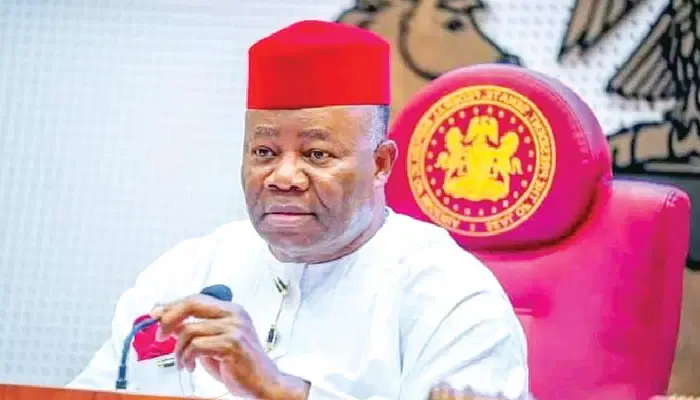
Senate President Godswill Akpabio has justified the Senate’s decision to reject mandatory real-time electronic transmission of election results, citing the absence of network coverage in at least nine states across Nigeria.
Akpabio made the clarification amid nationwide criticism that followed the Senate’s recent amendment of the Electoral Act, which removed compulsory real-time electronic transmission of results ahead of the 2027 general elections.
The decision has sparked widespread backlash from Nigerians, opposition political parties and professional bodies, including the Nigerian Bar Association (NBA), who have urged the National Assembly to reverse the move.
Speaking during the launch of a book by former senator, Effiong Bob, titled “The Burdens of Legislators in Nigeria,” Akpabio dismissed the criticism, insisting that it is the responsibility of the Independent National Electoral Commission (INEC) to determine the modalities for conducting elections.
The Senate President argued that enforcing real-time electronic transmission could disenfranchise parts of the country affected by insecurity and poor telecommunications infrastructure.
“Real-time transmission means that in over nine states where networks are not working because of insecurity, there will be no election results,” Akpabio said.
“Nationally, it means that if the national grid collapses and no network is working, no election results will be valid.”
He further stated that grievances over election technology deployment should be directed at INEC, not the legislature, stressing that the Senate’s role is limited to lawmaking.
“The Senate does not conduct elections, we don’t deploy technology, we only make laws. INEC must apply the law,” he said.
Akpabio also took a swipe at some critics of the Senate’s decision, accusing them of lacking an understanding of legislative processes.
According to him, “The timing, scope and modality of elections rest with INEC, acting within the framework of the law enacted by parliament and interpreted by the Supreme Court.”
The Senate’s position continues to fuel debate over transparency and credibility ahead of the 2027 general elections, as stakeholders remain divided on the role of technology in Nigeria’s electoral process.













BREAKING: Security Forces Rescue 20 Prospective NYSC Members, Civilian Abducted in Imo

State Police Must Protect Nigerians, Not Intimidate Them — Comrade Grace Ike

BREAKING: NLC declares indefinite strike in FCT

Lagos hosts Chartered Risk Management Institute’s silver jubilee conference, spotlights youth challenge and national awards

BREAKING: NAF names 25 people killed in ATR 42 crash in Ondo (Full List)

KONEF celebrates World Teachers’ Day, urges greater investment in teaching

Gov. bago swears in six new commissioners, tasks them on diligence

Police Arrest man for raping, impregnating 12-Year-Old in FCT

2027: ‘A Vote for Obi, NDC Is a Vote to Kill APGA’ — Anambra Govt

2027: ‘I Have Faith in God That Tinubu Will Return’ — Umahi
KONEF celebrates World Teachers’ Day, urges greater investment in teaching
Gov. bago swears in six new commissioners, tasks them on diligence
BREAKING: NAF names 25 people killed in ATR 42 crash in Ondo (Full List)
Lagos hosts Chartered Risk Management Institute’s silver jubilee conference, spotlights youth challenge and national awards
BREAKING: NLC declares indefinite strike in FCT
State Police Must Protect Nigerians, Not Intimidate Them — Comrade Grace Ike
BREAKING: Security Forces Rescue 20 Prospective NYSC Members, Civilian Abducted in Imo
-
 News2 days ago
KONEF celebrates World Teachers’ Day, urges greater investment in teaching
-
 News2 days ago
Gov. bago swears in six new commissioners, tasks them on diligence
-
 News2 days ago
BREAKING: NAF names 25 people killed in ATR 42 crash in Ondo (Full List)
-
 News1 day ago
Lagos hosts Chartered Risk Management Institute’s silver jubilee conference, spotlights youth challenge and national awards
-
 News15 hours ago
BREAKING: NLC declares indefinite strike in FCT
-
 NUJ FCT11 hours ago
State Police Must Protect Nigerians, Not Intimidate Them — Comrade Grace Ike
-
 News9 hours ago
BREAKING: Security Forces Rescue 20 Prospective NYSC Members, Civilian Abducted in Imo