
News
How Jonathan shelved fuel Subsidy Removal over Boko Haram threat – Sanusi

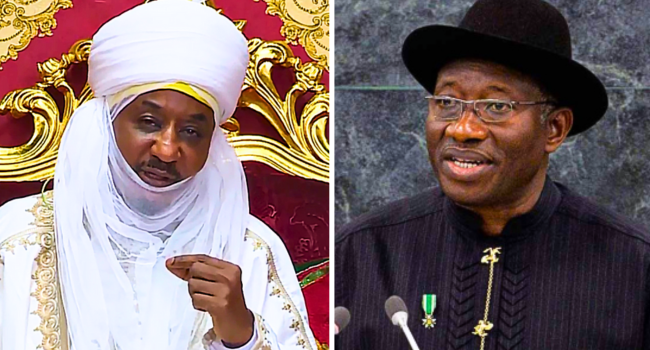
The Emir of Kano, Muhammadu Sanusi, has revealed that former President Goodluck Jonathan’s administration abandoned plans to remove the fuel subsidy in 2011 due to security concerns at the height of the Boko Haram insurgency.
Sanusi, who served as the Central Bank of Nigeria (CBN) Governor from 2009 to 2014, made the revelation at the Oxford Global Think Tank Leadership Conference in Abuja on Tuesday.
He explained that the current economic hardship in Nigeria is a direct result of the government’s failure to remove the subsidy more than a decade ago.
“The only reason the government compromised at that time and did 50 per cent to 100 per cent was Boko Haram. There were thousands of Nigerians on the streets in Lagos, Kano, Kaduna, and other cities. There was a fear that one day, one of these suicide bombers would go to these Nigerians and explode bombs, and you would have 200 corpses—it would no longer be about subsidy,” Sanusi said.
He, however, praised Jonathan for his determination to push through the reform despite public opposition.
“You have to give President Jonathan the credit. He was determined to do it, but at the end of the day, the compromise was made to save Nigerian lives,” he added.
Sanusi further stated that had the subsidy been removed in 2011, the economic challenges Nigerians now face would have been much milder.
“If Nigerians had allowed the Jonathan government to remove the subsidy in 2011, there would have been pain. But that pain would have been a very tiny fraction of what we are facing today. This is the cause of the delay,” he explained.
According to him, the CBN had already calculated the economic implications at the time.
“We worked out the numbers in the Central Bank. I stood up and put my credibility on the line and said, remove the subsidy today. Inflation moves up from 11 per cent to 13 per cent, I will bring it down in a year,” Sanusi recalled.
He maintained that Nigeria’s current inflation rate—now above 30 per cent—could have been avoided if the decision had been implemented earlier.
“We talk about these things because it’s important. There is a kind of poetic justice that it is actually the people who led the Occupy Nigeria movement who ended up inheriting the problem and having to do it,” he said.
President Bola Tinubu eventually removed the long-standing fuel subsidy during his inauguration on May 29, 2023.
The subsidy, first introduced in the 1970s to make fuel affordable, had become a massive financial burden on the government. Tinubu’s decision, supported by international partners, was aimed at stabilising public finances but triggered sharp increases in petrol prices, transportation costs, and food inflation.
By 2024, inflation had surged beyond 30 per cent, and nearly half of Nigerians were living below the poverty line. While critics argue that the policy worsened living conditions, supporters insist it was a necessary step to restore economic stability and promote long-term growth.














NUJ demands independent probe into deaths of 37 miners in NSCDC custody

Tunji-Ojo leads FG delegation to Niger over deaths of miners in NSCDC custody

IGP Disu visits Niger, vows thorough probe into deaths of 37 miners in NSCDC custody

INEC opens recruitment portal for 1.4 Million Ad Hoc Staff for 2027 elections

Police rescue eight kidnap victims in Benue forest, one dies from injuries

Soludo grants pardon to native doctor Akwa Okuko, gives him new role in Anambra

Appeal Court upholds NDC registration, says Lokoja Court abused judicial power

APC Campaign Council accuses Atiku of compromising Nigeria’s interests over Mambilla dispute

Tinubu orders full investigation into deaths of 37 miners in NSCDC custody

Gov Bago orders immediate curfew in Minna as tension mounts over miners’ deaths
Tinubu orders full investigation into deaths of 37 miners in NSCDC custody
APC Campaign Council accuses Atiku of compromising Nigeria’s interests over Mambilla dispute
Appeal Court upholds NDC registration, says Lokoja Court abused judicial power
IGP Disu visits Niger, vows thorough probe into deaths of 37 miners in NSCDC custody

Macron hosts Tinubu to private dinner in Paris (Photos)
Soludo grants pardon to native doctor Akwa Okuko, gives him new role in Anambra
Gov Bago orders immediate curfew in Minna as tension mounts over miners’ deaths
Police rescue eight kidnap victims in Benue forest, one dies from injuries
INEC opens recruitment portal for 1.4 Million Ad Hoc Staff for 2027 elections
Tunji-Ojo leads FG delegation to Niger over deaths of miners in NSCDC custody
-
 National News1 day ago
Tinubu orders full investigation into deaths of 37 miners in NSCDC custody
-
 News1 day ago
APC Campaign Council accuses Atiku of compromising Nigeria’s interests over Mambilla dispute
-
 News1 day ago
Appeal Court upholds NDC registration, says Lokoja Court abused judicial power
-
 News18 hours ago
IGP Disu visits Niger, vows thorough probe into deaths of 37 miners in NSCDC custody
-
 National News2 days ago
Macron hosts Tinubu to private dinner in Paris (Photos)
-
 News1 day ago
Gov Bago orders immediate curfew in Minna as tension mounts over miners’ deaths
-
 News1 day ago
Soludo grants pardon to native doctor Akwa Okuko, gives him new role in Anambra
-
 News1 day ago
Police rescue eight kidnap victims in Benue forest, one dies from injuries